


Orders

Profile

Baby Crowning During Birth: What is it and How Does it Feel?
 12 Likes|
 6 min
6 minExhausted? Painful? Nervous? Smooth? Numb? Exciting? What's your childbirth story, and how did you feel?
Welcoming your little one is such a life-changing event that the pain is quickly forgotten because all your focus automatically shifts to the baby, whether you like it or not. Your brain turns to mush, and you instantly love that little ball of dough more than anything else.
What is Baby Crowning During Birth and How Does it Feel?
Baby crowning is the moment when you see the top of your baby's head emerging through your vaginal opening. This happens during the second stage of labour when you are instructed to push and deliver your newborn. Once your baby's head crowns, you can push out the rest of their body.
Many women find it hard to describe because the sensations involved with pushing are so intense and overwhelming. If the tissues are not prepared, this can feel like a frequent burning and pinching pain in and outside your vagina. The process is referred to as 'The Ring of Fire'! Occasionally, the exit of the shoulders is more crucial than crowning but generally lasts a much shorter time.
Stages of Labour/Baby Crowning
Labour is divided into four major stages:
- Early or active Labour
- Delivery of foetus/Baby Crowning (birth)
- Delivery of the placenta
- Recovery
Stage 1- Early or Active Labour
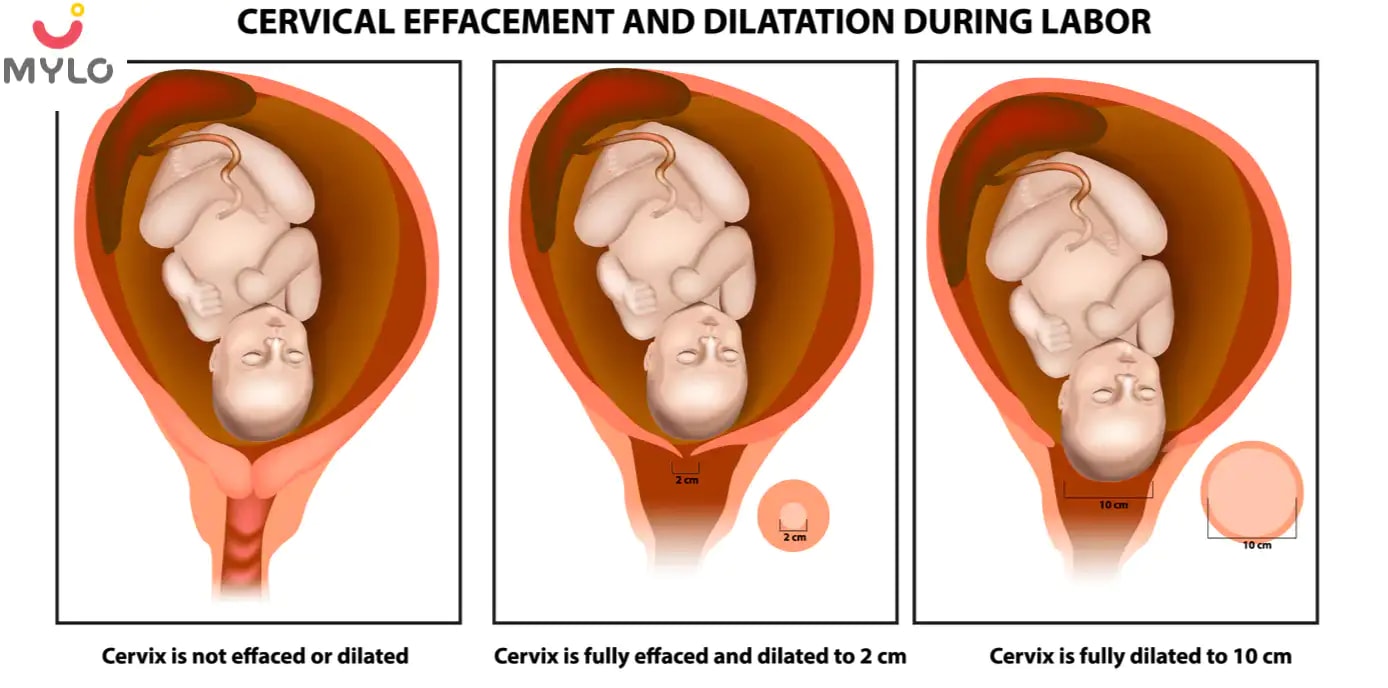
During vaginal or normal childbirth, the first stage of labour can last up to 19 hours and begins when your baby settles lower into your pelvis. In response, your cervix widens and starts becoming thinner and dilated.
During this phase, you may feel strong continuous contractions, occurring every 5 to 20 minutes, along with lower back pain and cramping that doesn't go away till childbirth. You may also see a brownish or reddish mucus discharge, which could be the mucus plug falling out at the opening of your cervix.
Your water may break with a huge gush of fluid or continuous trickle. If you experience any of the below symptoms, contact your doctor to see if you should go to the hospital:
- Strong, regular contractions
- Mucus plug
- Water breaking
Stage 2- Delivery of Foetus/Baby Crowning(birth)
At the start of stage two of labour, your cervix is fully dilated to 10 centimetres. This stage usually lasts from 20 minutes to two hours, which causes your baby's head to move beyond the cervical opening into your birth canal.
Your doctor will instruct you to push during your contractions and rest between them. In a vaginal delivery, your baby's head will rotate to face your back. Your uterus is divided into an active section during active labour that contracts while pushing the baby downward; and an inflexible passive section that remains relaxed, stretching to provide maximum room for the baby to pass through.
The top of your baby's head starts to appear. This is also known as crowning. Your surgeon may make a small cut to enlarge the vaginal opening. Then your doctor or midwife will give you instructions on pushing out your baby.
After performing an episiotomy, your baby's head passes through the birth canal and takes an elongated shape. An elongated head shape will shift back to normal within a few days as the skull bone shifts back into place.
Once your baby's head passes through the birth canal, their head and shoulders will also rotate to help the shoulders exit the birth canal. Your baby's shoulders are gradually delivered one after the other to pass through your pelvis.
Once the shoulders have emerged, the baby slides out easily.
Stage 3- Delivery of the placenta
The umbilical cord will be cut after your baby is born. In stage three of labour, which may last five to 30 minutes, mild contractions will help push the placenta out of the uterus. You and your baby may begin bonding through skin-to-skin contact and breastfeeding during this stage.
Stage 4- Recovery
Several hours after the delivery is called the fourth stage of labour. There are major physiological changes such as adaptation to the blood loss and the beginning of uterine involution, where the uterus tries to return to its pre-pregnancy stage.
Degrees of tear or Symptoms of a tear
During the Delivery or 'Baby crowning', your doctor may perform an episiotomy or a cut to enlarge the vaginal opening so that the baby can come out easily.
While doing episiotomy, several degrees of tears can occur, which are classified into four degrees of tearing:
1. First-degree tears
First-degree tears involve tearing of the skin along with the perineum tissue. It may recover with or without stitches.
2. Second-degree tears
Second-degree tears involve the perineum tissue and the internal tissue of the vagina. This kind of tear needs stitches that take a few weeks to recover.
3. Third-degree tears
Third-degree tears include the perineum tissue and a part of the muscle surrounding the anus. This tear usually requires surgery and may take longer to heal.
4. Fourth-degree tears
Fourth-degree tears include the perineum tissue, anal muscle, and a portion of the mucus membrane that furnish the rectal region. This tear is severe and requires surgery with a longer recovery time.
You may experience superficial symptoms with first and second-degree tears, like stinging or sharp pain while urinating. The symptoms are more severe, like Fecal Incontinence (inability to control bowel movements) and pain during intercourse with third and fourth-degree tears.
Tips to help you prepare for Baby Crowning
Relax! Some ways can help you prepare for the crowning experience:
- You must consider signing up for a childbirth class at your hospital (if they offer) to learn what to expect during labour and delivery. Can’t find a class nearby? No worries! You can also find them online.
- Learn about different birthing positions that may help ease delivery.
- Speak with your doctor about some pain management methods that will work for you. There are many options such as massage, breathing techniques, pelvic floor exercises, epidural, local anaesthesia, etc.
- Try to follow the doctor’s instructions and resist the urge to push too hard when you’re crowning. Relaxing will allow your tissues to stretch and also help prevent severe tearing.
- Remember, once you feel that sharp burning pain, you’re close to meeting your little one!
References
- American Pregnancy Association.(2021). Baby Crowning during Pregnancy. www.americanpregnancy.org
 Yes
Yes
 No
No
Your parenting partner
in your pocket.
supportive community.

Your parenting partner
in your pocket.
supportive community.


Article Posted Under
Helpful Tools & Calculators
.webp&w=32&q=75)














Priyanka is an experienced editor & content writer with great attention to detail. Mother to an 11-year-old, she's a ski
Related Articles



Questions about this article
- Asked when 38 weeks pregnant
Hello frnds..still no pain...doctor said head fix nhi hua hai..bt vagina me pain hai aur back pain bhi... anyone having same issues??
- Asked when 23 weeks pregnant
Kon kon c chije aisi hai jo pregnancy mei gas acidity jalan karti hain... Koi btayega plz bcz mujhe aksar khane ke baad hi samagh aata hai ki is chij se gas acidity jalan ho gyi hai. Please share your knowledge
- 14 weeks pregnant
I am 13 week pregnancy. Anyone having Storione-xt tablet. It better to have morning or night ???
- Asked when 10 weeks pregnant
Hlo to be moms....i hv a query...in my 9.5 wk i feel body joint pain like in ankle, knee, wrist, shoulder, toes....pain intensity is high...i cnt sleep....what should i do pls help....cn i cosult my doc.
- Asked when 33 weeks pregnant
Influenza and boostrix injection kisiko laga hai kya 8 month pregnancy me and q lagta hai ye plz reply me
Related Topics
.webp&w=32&q=75)
Recently Published Articles
Your body needs extra nutrition this trimester - these can help.

Malabsorption Syndrome: Types, Causes, Symptoms, & Treatment

Is Ghee Good During Pregnancy?

5 finance management tips for new parents
The Ultimate Guide to the Best Romantic Web Series on OTT for Couples

10 Amazing Home Remedies for Cough and Cold in Toddlers
Medical Disclaimer
This content is for informational purposes only and should not replace professional medical advice. Consult with a physician or other health care professional if you have any concerns or questions about your health. If you rely on the information provided here, you do so solely at your own risk.


AWARDS AND RECOGNITION

Mylo wins Forbes D2C Disruptor award

Mylo wins The Economic Times Promising Brands 2022
AS SEEN IN












- Mylo Care: Effective and science-backed personal care and wellness solutions for a joyful you.
- Mylo Baby: Science-backed, gentle and effective personal care & hygiene range for your little one.
- Mylo Community: Trusted and empathetic community of 10mn+ parents and experts.


Product Categories
Baby Carrier | Baby Soap | Baby Wipes | Stretch Marks Cream | Baby Cream | Baby Shampoo | Baby Massage Oil | Baby Hair Oil | Stretch Marks Oil | Baby Body Wash | Baby Powder | Baby Lotion | Diaper Rash Cream | Newborn Diapers | Teether | Baby Kajal | Baby Diapers Pants | Cloth Diapers | Laundry Detergent | Lactation Granules |