


Orders
.png&w=48&q=75 "login")
Profile


Wallet

Amazing Ways to Help Your Toddler Talk
 144 Likes|
 9 min
9 minThe more you chat to your toddler, the more opportunities she is likely to have to learn how to talk. But bear in mind that all children are different and learn to talk at different rates.
How can I help my toddler learn to talk?
The more fun your toddler has learning new words, the more likely she is to carry on using them. There are lots of ways you can help your toddler with learning to talk:
- Talk as much and as often as you can to your toddler. Watch her face carefully and look interested whenever she tries to talk to you.
- Focus on what your toddler is trying to say, rather than on how clearly she pronounces her words. Try to help your toddler feel confident about talking to you.
- When she does communicate successfully, give her clear feedback. For example, you may tell her "Yes, that's right, it is a spoon."
- Let your toddler see what you mean, by matching what you do to what you say. "Shoes off" you could say, removing her shoes. Then "socks off", removing her socks.
When you give your toddler her lunch, put the plates on the table and then hold out your hand to her saying, "It's lunchtime now". She will understand that her lunch is ready and will come to the table, because she has smelt the food and seen you setting the table. She may not have understood the words "lunchtime now" without those other cues to go with them.
Here are some more tips you can use:
- Get your toddler's attention by saying her name before you talk to her and making eye contact with her. This will help her understand when you are talking to her.
- Give your toddler plenty of opportunities to talk during everyday activities. If you ask her a question, leave a 10-second pause, so that she has time to answer you.
- Expose your toddler to new situations where you can introduce more words. Take her for a walk. Point out things you see when you're out and about.
- Repeat back what you hear your toddler trying to say to you, even if she doesn't say it clearly. Expand on what she says. So if your toddler says "nana" when she wants a banana, you could say "Yes, here's a banana."
- Simplify your speech. Use short sentences and emphasise key words when you are talking to your toddler. This will help her to focus on the important information.
- Switch off unnecessary background noise such as the TV, music player or radio. This will help your toddler to focus her attention on you when you are talking to her. Children can find it harder than adults to filter out background noise.
How can I make learning to talk fun?
It's easy to be motivated to do something you enjoy. So it follows that if you make talking fun for your toddler, it will encourage her to use words to express herself.
1. Teach through play
Get down on the floor and play with your toddler. Let her choose the toy or activity and talk about what she's doing. By joining in with your toddler's play, you'll give her lots of opportunities to hear clear examples of the words she's using.
Have fun pretending your toddler's favourite teddy or action figure is real. Include the toy in everyday activities. Sit your toddler's teddy at the table for a meal, for example, and put a bib on her. Talk about what teddy is doing while she does it.
Play games where you have to take turns. Turn-taking skills will help your toddler learn how to contribute to conversations.
2. Use story time
Look at books with your toddler often. Even if you don't read the story as it happens, she will learn by listening to you talking about the pictures.
If you're reading one of her eternal favourites, begin reading the story and then pause occasionally so she can fill in the blanks. Prompt her if you need to and have her repeat after you. Each time you read the book, pause at a different point in the story so she can work on the pronunciation of new words.
After the hundredth reading of her favourite book, you shouldn't be too surprised to learn that your child has memorised this story. Here's a way to let her shine, while getting her to practise her ever-developing verbal skills.
You may like: Top 10 Panchatantra Stories for Babies & Kids
3. Make a song and dance!
Have fun with nursery rhymes, especially those with actions such as "Row, row, row your boat" or "Machli jal ki rani hai!". The more you do this, the more likely your toddler is to join in.
4. Rehash the day
For a toddler, every day is an adventure. Watching you while you shop for groceries, or get ready for work or get dinner organised can be great fodder for discussion.
Every night before bed, talk through the day's events. If your child still speaks in one or two-word spurts then you can get the details by asking very specific questions.
Say, your child tells you she went to the playground. Get more specifics with questions like: Who took you there? Who did you play with? Which toy did you like most? Try to frame your questions so that they require more than a yes or no response.
Reviewing the day's events can be especially helpful to parents of children in daycare because it helps you catch up on your child's activities.
5. Try word games
Speaking is infinitely more appealing when it's made into a game. Younger toddlers will like a game called "What's this?" When you're in a new environment such as a restaurant, a coffee shop, an airport, or the corner market point to something and ask, "What's this?" Challenge your child to come up with the correct name. To keep her from getting frustrated, start out with a few objects you're sure she knows - a car, a cup, a spoon, a TV and so on.
Then every once in a while sneak in a new word. If she doesn't know, whisper the answer and let her shout it out. Then, tell her what the object is and how it functions. ("That's an umbrella. We use umbrellas to keep rain and the bright sun off our heads.")
6. Chat on the phone
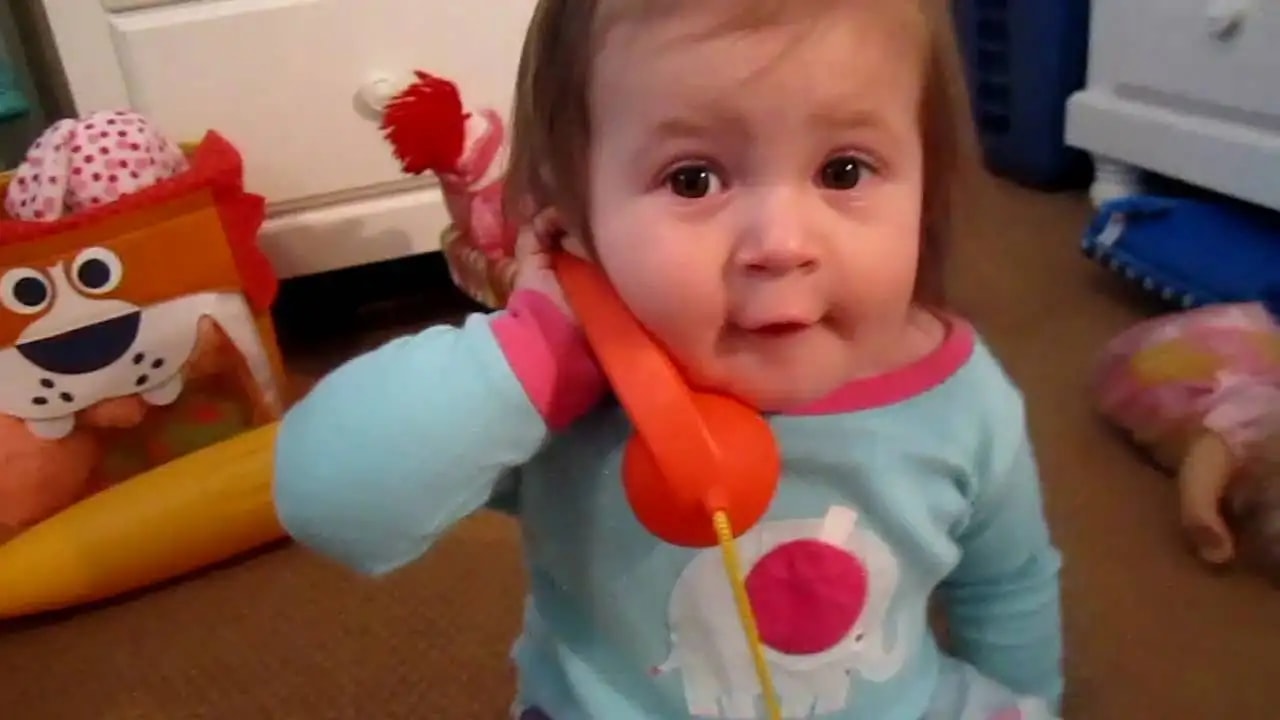
Most children develop a fascination with the phone long before they can talk. Use that allure to get yours chatting. When your husband, friends and family call, put your toddler on for a little while. With no visual cues to help, your child will be forced to hone her pronunciations.
When she starts to get frustrated, however, it's a good idea to step in and translate. Ask the caller to pose simple questions. If she won't answer them, coax her with some questions of your own. For example, "Can you tell Nani what you ate for lunch today?" or "What toys did you play with today?"
7. Record her on video
Most toddlers love to perform for the camera. Turn on yours, shout "action," and see how your child reacts.
Some toddlers need no encouraging at all and will immediately ham it up. Others may need a little more stage direction. If your child has a favourite rhyme or song, ask her to perform it. Ask a series of questions, TV-interview style. To keep her interested, play back the video right away. Once she sees and hears herself, she'll be more excited to give an encore performance.
Try listening games
- Clapping games, where you clap a pattern (say, one clap first and then one clap followed by two short ones), and then wait for your toddler to try to clap the same pattern.
- Choosing the correct picture or animal toy when you make an animal noise. For example, you say "bow wow" and wait for your toddler to pick out a toy dog.
- Gathering together several toys that make noises, and making a sound with one of them out of your toddler's sight. Your toddler then has to decide which toy it was that made the noise.
You could also try a game of "Simon says". Call out simple commands like "Simon says, put your hands on your head" and demonstrate the command yourself. Then let your toddler do the same. Carry on with other commands, such as "Simon says put your hands on your knees", or "Simon says touch your nose."
And when the weather's pleasant take a big sheet or mat into the garden, the neighbourhood park or even your balcony and lie down on it with your toddler. Ask her to close her eyes and listen carefully. After a minute or so ask her what she could hear. You can then talk about the wind in the trees, birdsong, the traffic noises, flying planes or a dog barking.
You may like:
References
- NHS. Help your baby learn to talk. https://www.nhs.uk/conditions/baby/babys-development/play-and-learning/help-your-baby-learn-to-talk/
- NCT. How can you encourage a child’s language development?. https://www.nct.org.uk/baby-toddler/learning-talk-and-communication-your-baby/how-can-you-encourage-childs-language-development
Article Posted Under
Related Articles

Related Topics
.webp&w=32&q=75)
Medical Disclaimer
This content is for informational purposes only and should not replace professional medical advice. Consult with a physician or other health care professional if you have any concerns or questions about your health. If you rely on the information provided here, you do so solely at your own risk.


AWARDS AND RECOGNITION

Mylo wins Forbes D2C Disruptor award

Mylo wins The Economic Times Promising Brands 2022
AS SEEN IN












- Mylo Care: Effective and science-backed personal care and wellness solutions for a joyful you.
- Mylo Baby: Science-backed, gentle and effective personal care & hygiene range for your little one.
- Mylo Community: Trusted and empathetic community of 10mn+ parents and experts.


Product Categories
Baby Carrier | Baby Soap | Baby Wipes | Stretch Marks Cream | Baby Cream | Baby Shampoo | Baby Massage Oil | Baby Hair Oil | Stretch Marks Oil | Baby Body Wash | Baby Powder | Baby Lotion | Diaper Rash Cream | Newborn Diapers | Teether | Baby Kajal | Baby Diapers Pants | Cloth Diapers | Laundry Detergent | Lactation Granules |